

-
 Sold out
Cashew Tree, Red Fruit
Regular price From $29.95 USDRegular priceUnit price per$39.95 USDSale price From $29.95 USDSold out -
Cashew Tree, Yellow Fruit
Regular price From $34.95 USDRegular priceUnit price per$124.95 USDSale price From $34.95 USDSale -
 Sold out
Cashew Tree, Pink Fruit
Regular price $94.95 USDRegular priceUnit price per$119.95 USDSale price $94.95 USDSold out


Cashew trees for sale at Everglades Farm are grown in our Homestead, Florida nursery and shipped in their containers as live fruit trees. The cashew tree (Anacardium occidentale) is an evergreen from northeastern Brazil and a cousin of the mango.
Cashew Tree Varieties
Cashew tree varieties in Florida are few. Almost no named varieties are sold in the state, so nursery trees here, ours included, are seedlings. We raise them from cashew seeds and sell them by the color of the cashew apple they bear.
Available cashew tree varieties
- Cashew Tree, Yellow Fruit bears a yellow cashew apple. It is in stock now in the 1-gallon size, 12 to 24 inches tall.
- Cashew Tree, Red Fruit bears a red cashew apple. It is offered in 1-gallon, 3-gallon and 7-gallon containers and is currently sold out.
- Cashew Tree, Pink Fruit bears a pink to light red cashew apple. It comes in a 3-gallon container and is currently sold out.
Characteristics
All three share the same characteristics apart from fruit color. They are evergreen and they need the same care. Each bears a cashew apple, the swollen stem behind the nut, and a nut whose shell holds a caustic oil. Germination takes two to four weeks, and seedlings begin to bear three to four years after planting. Because they are seedlings, no two trees grow or fruit exactly alike.
Suitability for different growing conditions
Every cashew variety needs frost-free weather, so color is a matter of taste and not of climate. In extreme South Florida any of them can go in the ground, in sand or on rockland. Anywhere colder, keep a potted cashew tree in a large container and bring it under cover on cold nights. The 1-gallon size is the easiest to start that way.
Commercial varieties
Commercial varieties are a different matter. Growers in Brazil plant two types. The common type, called gigante, is a tall tree that bears late, or tardio in Portuguese. The early dwarf type, called anao precoce, stays small and bears young. These selections are not sold to home growers in the United States.
Cashew Tree Anatomy
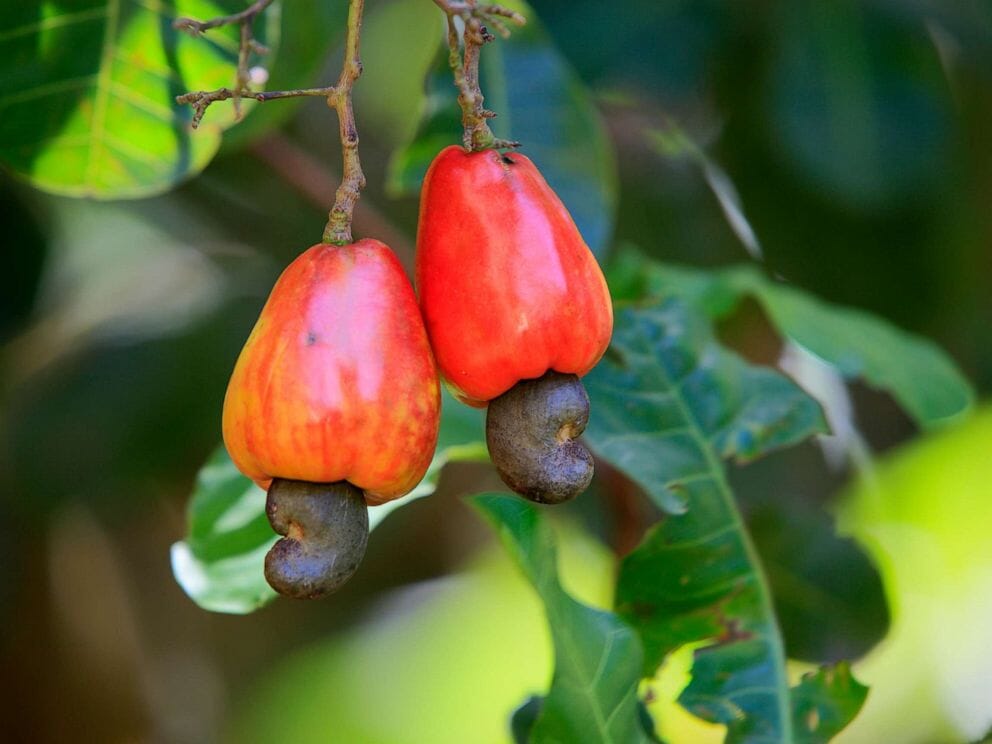
Cashew tree anatomy is unusual because the part most people call the fruit is not the fruit. The tree belongs to the Anacardiaceae family, along with mango and pistachio, and it grows two things on one stalk.
The tree
The cashew tree is an evergreen with smooth brown bark and a dense, spreading canopy. It reaches 15 to 25 feet in Florida. The leaves are leathery and oval, 6 to 7 inches long. The trunk branches low, so an unpruned tree spreads wide.
Flowers
The flowers are small, with pinkish to whitish petals, and are carried on panicles 4 to 8 inches long at the ends of the branches. A panicle holds 200 to 1,600 flowers. About 60% are male and the rest are bisexual, and only 1 to 6 fruit set per panicle.
Fruit structure: the cashew nut
The cashew nut is the true fruit. It is kidney-shaped and has a double-walled shell. A thick outer exocarp and a hard inner endocarp are separated by a spongy mesocarp filled with a caustic, reddish-brown oil. Inside sits the edible kernel. What stores sell as cashew nuts are these kernels, and they are the cashew seeds.
The relationship between the cashew apple and the cashew nut
The cashew apple is an accessory fruit. After a flower is pollinated the nut forms first at the tip of the stalk. Then the receptacle behind it, at the end of the pedicels that carry the flowers, swells into a juicy, pear-shaped body 2 to 4 inches long. That is the cashew apple. It ripens yellow or red with the nut still hanging from its lower end.
Climate and Soil Requirements for a Cashew Tree
Climate and soil requirements decide whether a cashew tree will grow in your yard, so check them before you order.
Climate conditions
The cashew tree needs a tropical climate. It grows best between 63°F and 100°F and does not tolerate even a short frost. In the continental United States that means extreme South Florida. Elsewhere, grow it in a large container and move it under cover before a cold night. It is at home in seasonally dry tropical climates, where a dry spring helps flowering. Relative humidity of 65% to 80% suits it. Annual rainfall of 27 to 78 inches is ideal, and an established tree is drought tolerant.
Soil types
Cashew grows best in deep sandy soils with a pH of 4.5 to 6.5, an acid to moderate pH level. It needs well-draining soil. It stands an occasional brief flood but fails on ground that stays wet. It also grows on the limestone soils of Miami-Dade County, where the pH runs 7.4 to 8.5 and nutrient deficiencies of iron, zinc and manganese are common and easy to correct.
Environmental requirements
Give the tree full sun and room, 15 to 20 feet or more from buildings and other trees. Keep soil moisture steady while it is young. Once it is established, irrigation is needed only in a long dry spell.
Cashew Tree Propagation and Planting
Propagation and planting of a cashew tree are covered together here. The tree is propagated by seed, air layering, cuttings and grafting, and it is planted differently in sandy and rockland soils.
Seed propagation
Seed propagation is the method that suits a home landscape, and it is how our trees are raised.
Finding viable cashew seed is the hard part, because store nuts have been heated. Put fresh seeds in water and discard the ones that float. Soak the rest for 24 hours and plant them about 2 inches deep. They sprout in two to four weeks.
Air layering
Air layering is the preferred way to propagate a cashew tree by vegetative means. It works best in summer, during peak shoot and leaf growth.
Stem cuttings
Stem cuttings root best from semi-mature wood. They need a light, well-aerated growing medium, shade from direct sun and continuous high humidity, which in practice means misting.
Grafting and budding
Cashew can be propagated by veneer-grafting or side-grafting, and by shield-budding or patch-budding. The work is done just before new buds sprout.
Whatever the method, start with a healthy tree when you plant. Avoid a large tree in a small container, because its root system may be root bound. May through August, the rainy season, is the best time to plant.
Planting in sandy soil
- Choose the warmest spot in the yard that does not flood.
- Remove a ring of grass 3 to 10 feet across.
- Dig a planting hole three to four times the diameter of the container and three times as deep.
- Backfill with the native soil. If you add compost, keep it to half the mix.
- Set the tree so the top of the root ball is level with the ground or slightly above it. Fill, tamp lightly and water at once.
Planting in rockland soil
On rockland soil, break up the limestone with a pick and digging bar to the same dimensions, or hire a company with augering equipment. Then plant as you would in sand.
Mound planting
Where the ground floods or stays wet after rain, plant on a mound of native soil 3 to 4 feet high and 4 to 10 feet across. The mound keeps the roots above standing water.
After planting
Staking with a wooden or bamboo stake is optional. Tie with natural fiber string, never wire or nylon rope. Water often enough to prevent soil drying around the root ball in the first weeks. That is the best guard against transplant shock.
Cashew Tree Care and Maintenance
Tree care and maintenance for a cashew tree means fertilization, irrigation, mulching and a little thought about the lawn around it. A young tree needs steady attention for its first three years and much less after that.
Fertilization
Fertilize a young tree every month in its first year. Start with a quarter pound of fertilizer and work up to one pound. A mix such as 6-6-6-2 or 8-3-9-2 suits it. In the second and third years, drop to three or four applications a year. Add two to four nutritional sprays a year with zinc, manganese, boron and molybdenum. On calcareous soils, apply chelated iron as a soil drench two or three times a year. On acid pH soils a different chelate or plain iron sulfate does the job.
Irrigation
Irrigation matters most at the start. Water a new tree at planting, every other day for the first 7 to 10 days, then once or twice a week for the first couple of months. After four years, watering is needed only in a very long dry spell in spring or summer.
Mulching
Mulch holds soil moisture and keeps weeds down. Spread 2 to 4 inches of bark or wood chips out to the drip-line and keep the mulch 8 to 12 inches back from the trunk.
Lawn care considerations
Lawn care is where many yard trees get hurt. Trunk injury from lawn mowers and weed eaters is common, so keep a grass-free area 2 to 5 feet or more out from the trunk. Lawn sprinkler systems on a timer can overwater a cashew tree and cause root rot, so keep the tree out of their reach. Do not use weed-and-feed products with atrazine near it.
Pruning a Cashew Tree
Pruning a cashew tree keeps it low enough to pick from and supports healthy growth. The pruning practices change as the tree ages.
Formative pruning
Formative pruning in the first two years encourages lateral branching. Use tip pruning: take 1 to 2 inches off every shoot tip in spring and summer. The result is a compact tree with many fruiting branches.
Pruning a bearing tree
Prune soon after harvest. Cut the top of the tree canopy back to hold tree height at 10 to 12 feet. Selective removal of a few upper limbs back to their crotches each year keeps the job small and lets light into the canopy. A lower tree is easier to care for and less exposed to storm damage.
Large trees
Pruning of large cashew trees should be left to a professional arborist who is licensed and insured.
Cashew Tree Pests and Diseases
Pests and diseases of the cashew tree are manageable in a home landscape. Most disease trouble comes in wet weather around bloom.
Insect pests
Insect pests fall into three groups. Insect borers tunnel in the wood. These borer pests are the larvae of beetles and moths. Beetles, caterpillars, thrips and mirids feed on flowers and leaves. Plant bugs, beetles and caterpillars attack the fruit. Check the tree from time to time, and ask your county extension office before you spray.
Diseases
- Anthracnose shows as black or reddish-brown, slightly sunken spots. It blights flowers, spots leaves and rots young fruit after rain or heavy dew.
- Powdery mildew coats flowers and young fruit with whitish, powdery growth and can stop fruit set.
- Alga spot starts as green-gray spots that turn rust red on leaves and stems. On stems it can lead to bark cankers.
- Phytophthora root rot attacks the roots on poorly drained soil. It causes chlorosis, wilting, leaf drop and dieback.
How to manage them
Management starts with placement. A tree in full sun dries quickly after rain, and a tree on well-drained ground does not get root rot. Where disease has been a problem, fungicide applications go on when the flower panicles are half grown and again 10 to 21 days later. Copper is used for anthracnose and alga spot, and sulfur for powdery mildew. Sprays applied after infection do not stop it.
Cashew Harvest and Storage
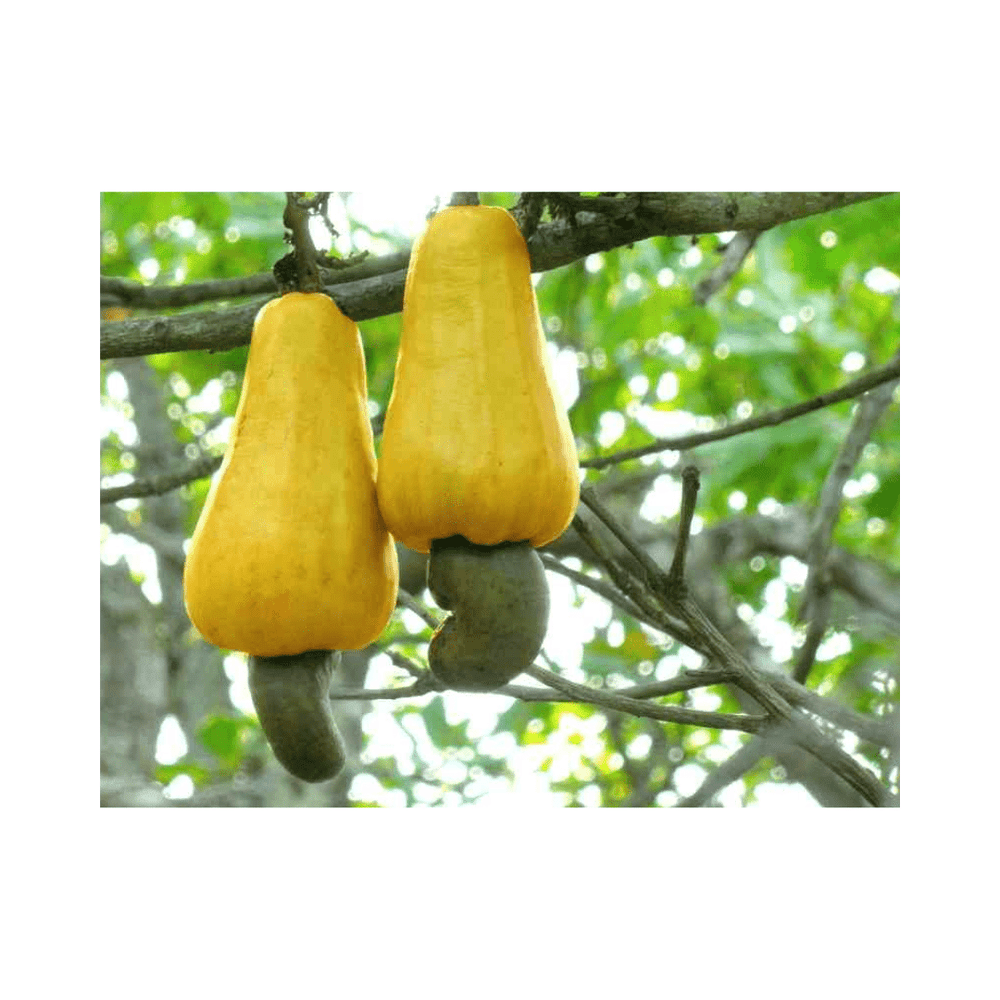
Harvest and storage of cashew are simple once you know what to look for. In South Florida flowering comes in spring and the crop follows two to three months later.
Ripening
The cashew nut reaches maturity first. It turns from green to grayish brown 50 to 60 days after flowering. The cashew apple needs another 20 to 30 days. It is ripe when it has turned fully from green to yellow or red.
When and how to harvest
Harvest the cashew apple from the tree when it is fully colored, or pick it up soon after it drops. Twist the nut off the lower end with gloves on.
Storage
A cashew apple does not keep at ambient temperatures. Put it in a polyethylene storage bag in the refrigerator and eat it soon. For planting, dry the nuts in the sun and keep them in an airtight container. They stay good for 7 to 12 months.
Do not shell the nuts at home
Cashew nutshells hold an oil that blisters skin. Commercial processing uses special equipment and roasting to drive it off before shelling. This should not be tried at home, because the fumes can damage the lungs.
Cashew Production and Crop Yields
Production and crop yields from a cashew tree in a home landscape are modest, and a few things decide how much fruit you get.
Expected crop yields
Seedling trees begin fruit production three to four years after planting. A mature tree can produce 50 to 75 pounds of fruit a year, counting cashew apple and nut together.
Factors that influence production
Most flowers are male and only the bisexual flowers can set fruit, so the crop always looks small next to the bloom. Wet weather during flowering and fruit set cuts yields hard. Shade does too, which is one more reason to plant in full sun. Where bees are scarce, flowers can be hand pollinated with a small brush to increase fruit set. Because trees grown from cashew seeds vary, two trees side by side may not bear alike.
Where cashew is grown commercially
There is no commercial crop in the United States. India, Ivory Coast, Vietnam and Brazil are among the leading producers.
Cashew Uses and Nutritional Value
The uses and nutritional value of cashew differ between the cashew apple and the cashew nut.
Uses of the cashew apple
The cashew apple is eaten fresh, though it can be astringent because of its high tannin content. Steaming it or boiling it in salted water for 15 minutes takes the edge off. The fruit is canned in syrup or made into chutneys and fruit pastes. It is high in pectin, so it sets well in jams and jellies. The juice is drunk fresh and ferments readily into wine.
Uses of the cashew nut
The kernel is roasted and eaten whole or ground into a creamy nut butter.
Nutritional value
The nutrient value of the cashew apple is mostly vitamin C. The juice has 100 to 500 milligrams per 100 milliliters, several times more than orange juice. The fruit is 84% to 90% water with 9 to 10 grams of carbohydrates per 100 grams. The nut is far denser. A 100 gram serving has about 553 kilocalories, 44 grams of fat and 18 grams of protein.
