

-
Mamoncillo Tree from Seedling, Spanish Lime
Regular price From $37.95 USDRegular priceUnit price per$49.95 USDSale price From $37.95 USDSale -
Montgomery Mamoncillo, Air Layered Tree, Spanish Lime
Regular price From $34.95 USDRegular priceUnit price per$54.95 USDSale price From $34.95 USDSold out -
Mamoncillo Tree Grafted, Spanish Lime
Regular price From $39.95 USDRegular priceUnit price per$79.95 USDSale price From $39.95 USDSold out


Mamoncillo trees for sale at Everglades Farm are grown in our Homestead, Florida nursery and shipped in their containers as live fruit trees. Mamoncillo (Melicoccus bijugatus) goes by Spanish lime, quenepa, genip and guinep depending on who raised you, and the tree behind all those names is the same one. This collection carries three: a seedling tree, the air layered Montgomery variety and a grafted tree.
Mamoncillo Varieties
Mamoncillo varieties are few, and that makes the choice easier than it is with mango or avocado. Three named varieties are grown in Florida: Montgomery, Jose Pabon and Large.
- Montgomery Mamoncillo, Air Layered is the named variety we propagate. The fruit is large, with about 51.5% pulp. An air layered tree is a clone, so it fruits like its parent.
- Mamoncillo Tree, Grafted is also a clone of a mature tree, set on seedling rootstock. Grafts take poorly on this species, which is why grafted stock costs more.
- Mamoncillo Tree from Seedling is raised from seed. Varieties do not come true from seed, so fruit size and sweetness vary from tree to tree.
Montgomery, Jose Pabon and Large
Montgomery was selected at the Montgomery Estate in Coral Gables, Florida. Its fruit is large, sometimes carries two seeds, has good flavor and is borne heavily in most years. Jose Pabon and Large are the other two varieties named in University of Florida literature. Jose Pabon and Large are not in our nursery today. If another seller offers one, ask whether the tree is air layered or grafted, because a seedling of a named variety is not that variety.
Which mamoncillo variety suits you
Choose Montgomery if you want known fruit quality and a shorter wait. Choose the seedling if you want a shade tree or a second tree for pollination. Sizes here run from a 1-gallon tree at 1 to 2 feet, through 3-gallon containers at 2 to 3 feet, to a 7-gallon tree at 4 feet.
Where to Buy Mamoncillo Fruit and Live Trees
Where to buy mamoncillo depends on whether you want fruit this summer or a tree for the next thirty years.
Buying mamoncillo fruit
The fruit is grown commercially across the Caribbean and Central America. In Florida it comes from backyard trees and a few small groves, so distribution is thin. In South Florida you find it from June to September at roadside stands and at Latin and Caribbean markets, in limited quantities. Specialty fruit retailers ship boxes by pre-order during the season and sell out quickly.
Buying live mamoncillo trees
We do not sell the fruit. Everglades Farm is a plant seller, and what ships from here is a live fruit tree in its container, with slow-release 8-3-9 fertilizer already in the soil. If you grew up calling it arbol de quenepa, this is that tree. The seedling tree is in stock now in 1-gallon and 3-gallon sizes. Montgomery and the grafted tree are currently sold out.
Mamoncillo Plant Description
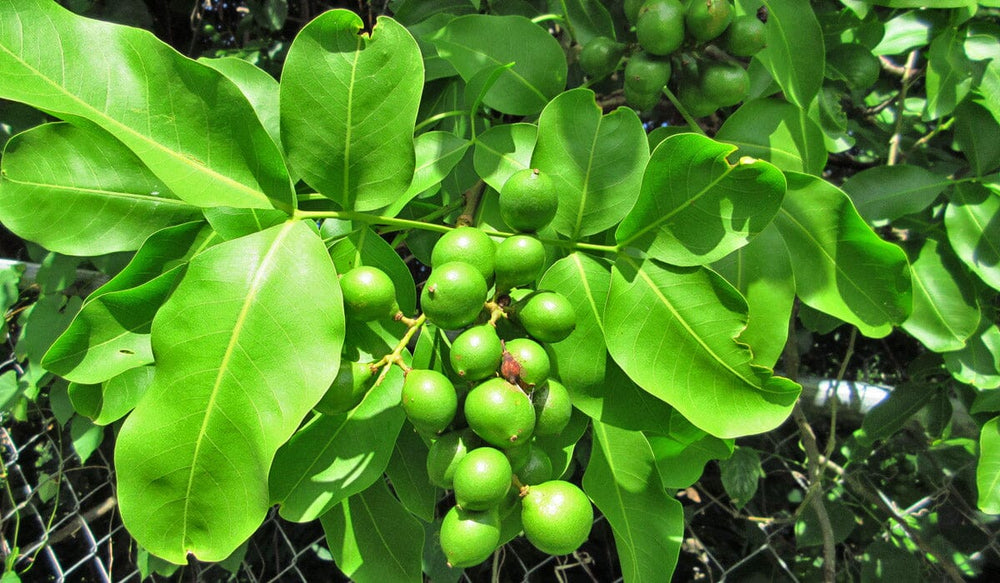
The plant description of mamoncillo starts with size. Melicoccus bijugatus is a medium to large tree with a round or oval canopy, and old specimens in the tropics pass 80 feet. In a Florida yard, pruned, it is kept at 12 to 15 feet. It belongs to the soapberry family with lychee, longan and rambutan.
Leaves
The leaves are compound, each with four elliptic leaflets 2 to 5 inches long set in two opposite pairs.
Flowers
The flowers are small, white and fragrant, carried on racemes 1 to 4 inches long at the branch tips in April and May. The species is mostly dioecious, meaning male and female flowers sit on separate trees. Some trees are partly polygamous and carry both. Bees do the pollinating. One tree may fruit alone, but two trees give a far better chance of a crop.
Fruit
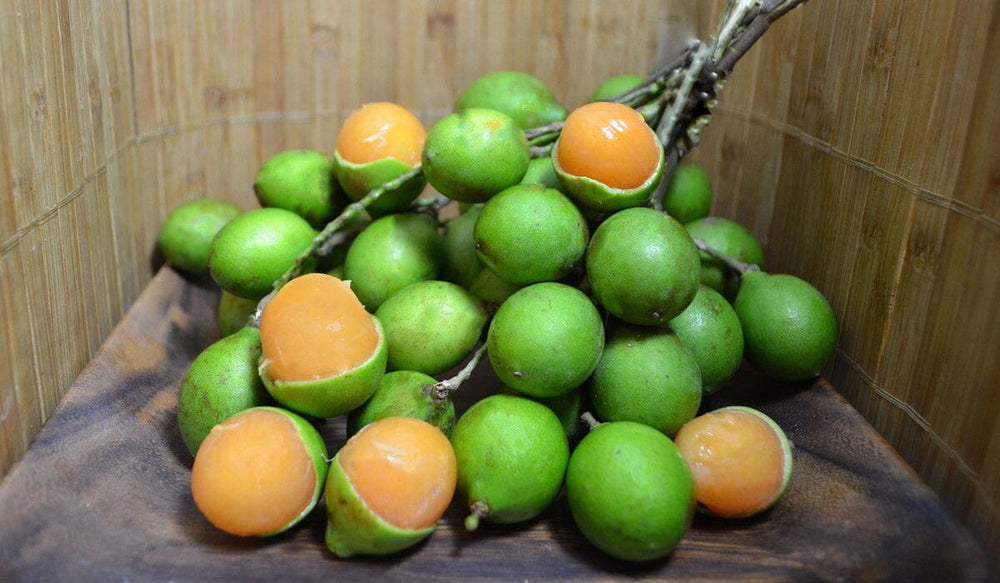
The fruit hangs in loose clusters. Each one is a green drupe about the size of a large grape, with a thin, leathery, brittle skin you crack with your teeth. Inside, a translucent salmon to yellowish pulp clings to one large seed, sometimes two. Nursery mamoncillo trees in 3-gallon containers arrive 2 to 3 feet tall and are years away from that picture.
Growing Conditions for Mamoncillo
Growing conditions for mamoncillo come down to warmth and drainage. Get those two right and the tree asks for little else.
Climate
The climate mamoncillo wants is tropical. The tree is well adapted to tropical areas and warm subtropical areas, which in the continental United States means South Florida. It is grown as far north as Fort Myers on the west coast and Palm Beach on the east. Young trees are damaged or killed below 32F. Mature trees take 27 to 28F before serious damage. North of USDA zone 10, grow it in a large container and move it under cover on cold nights.
Soil types
Soil type matters less than drainage. Mamoncillo grows in sandy soils of high or low pH and in the high-pH calcareous soils of Miami-Dade County. It tolerates long drought once established. It does not tolerate flooding, so avoid any spot that stays wet after summer rain.
Geographic regions
The tree is native to northern South America and is grown throughout the Caribbean and Central America. In Puerto Rico, Jamaica, Cuba and the Dominican Republic it is a street-corner fruit every summer.
Mamoncillo Planting Guide
The planting guide for a mamoncillo tree has three parts: site selection, digging the hole for your soil type and shaping the young tree. It follows the cultural practices the University of Florida recommends for a nursery tree going into a home landscape.
Site selection
Site selection comes first. Pick the warmest part of the yard in full sun, at least 25 feet from other trees, buildings and power lines, on ground that does not flood.
Planting in sandy soils
- Clear a ring of grass 3 to 10 feet across.
- Dig a hole three to four times the diameter of the container and three times as deep.
- Backfill with the native soil. If you add compost, keep it to half the mix.
- Set the nursery tree so the top of the root ball is level with the surrounding soil or slightly above it. Fill, tamp lightly and water at once.
- Stake with natural fiber string if the site is windy. Never use wire or nylon rope.
Planting in rockland soils
Rockland and other calcareous soils in Miami-Dade County sit on limestone a few inches down. Break the rock with a pick or digging bar, or hire an auger, to the same dimensions as the hole for sandy soils, then plant the same way. Where the water table sits within 7 feet of the surface, plant on a mound of native soil 2 to 3 feet high and 4 to 10 feet across. Mamoncillo needs well-drained soils more than rich ones.
After planting
Leave the tree unpruned through its first year and start the fertilizer program once new growth appears. In the second spring, begin heading back the main stem to force branching. Keep four or five well-placed branches and tip new shoots when they reach 3 feet.
Mamoncillo Tree Care & Maintenance
Tree care and maintenance for mamoncillo is light once tree establishment is behind you, which takes about three years.
Fertilization
Fertilization starts small. Feed a young tree every eight weeks with a quarter to half a pound of a fertilizer close to 8-3-9 with magnesium, and raise the amount as the tree grows. From the fourth year, cut back to one or two applications a year between March and August. Nitrogen after August pushes leaves at the expense of flowers and fruit production. On limestone soils, add a chelated iron drench and a foliar spray of zinc and manganese once or twice a season.
Watering
Irrigation matters most in the first years. Water a new tree regularly until it is established. A bearing tree needs water only in dry spells between flowering and harvest. Stop by the end of August and leave the tree dry through winter. Keep it out of reach of lawn sprinklers on timers, since constant wet causes root rot.
Mulching
Mulching with 2 to 6 inches of bark or wood chips out to the drip-line holds moisture and keeps weeds down. Keep the mulch 8 to 12 inches back from the trunk. Keep mowers and string trimmers back too. Trunk injury from a weed eater weakens the tree and can kill it.
Pruning
Pruning after harvest, from late summer into October, holds a mature tree at 12 to 15 feet where you can reach the fruit. Thin crowded inner branches for light and air, and remove dead wood. A tree that has outgrown its space beside a house is a job for a professional arborist.
Pests and diseases
Insect pests are few on mamoncillo, and diseases are uncommon. The one to watch in humid summers is red alga, which shows as rusty patches on leaves and limbs and can cause dieback.
Mamoncillo Propagation Methods
Propagation methods for mamoncillo are seed, air-layering and grafting, and the method decides how long you wait for fruit.
Seed
Seed is the easy way. Seedling trees are vigorous, but they take 8 to 10 years to begin fruit production, the fruit will not match the parent, and you cannot know whether a seedling is male or female until it flowers.
Air-layering
Air-layering, also called marcottage, is the standard vegetative propagation for this tree and the one a home grower can do. Choose branches about 2 inches in diameter during the warm months, girdle the bark, wrap the cut in damp sphagnum and expect rooting in five to six weeks. The new tree is a clone and bears years sooner than a seedling.
Grafting
Grafting onto seedling rootstock works, but the take is inconsistent even for nurseries. That is why grafted mamoncillo is scarce.
Mamoncillo Harvest, Storage & Uses
Harvest, storage and uses are simple for mamoncillo, with one catch: the fruit never changes color.
When and how to harvest
Harvest in Florida runs from June through September, late in the growing season. Clip the whole cluster, then clip each fruit from it. Pulling fruit tears the skin at the stem.
Ripening
Ripening happens only on the tree, and ripe fruit stays green, so judge by fruit size and by tasting one. The fruit is ready when the flavor is sweet with a little tang.
Storage
Storage is short. The fruit keeps a few days at room temperature and a few more under refrigeration.
Culinary and nutritional uses
Most mamoncillo is eaten fresh. Crack the skin, pop the fruit in your mouth and work the pulp off the seed. The flavor sits between lychee and lime. The pulp also goes into jams, jelly and cold drinks. A 100 gram serving carries 58 to 73 calories, mostly carbohydrate, with small amounts of the micronutrients iron, calcium and phosphorus and some vitamin C. The juice stains cloth, and the seed is a choking risk for small children, so hand it out with care.
