

How to Make a Soursop Tree Bear Fruit and Know When Soursop is Ripe – Step-by-Step Guide
Growing a soursop tree is one of the most rewarding projects for a warm-climate yard or large patio container, but getting reliable fruit can test any gardener's patience. It is common to see a vigorous tree produce dozens of blooms for years without setting a single crop, only to suddenly take off once its specific needs are met. This guide breaks down what actually triggers fruit production, how to hand-pollinate for heavy yields, and how to tell the exact moment your fruit is ripe for harvest.
What Is Soursop: Tree Characteristics and Origins
The soursop tree, classified botanically as Annona muricata within the Annonaceae family, is a tropical evergreen fruit tree native to Central America and South America. Over centuries of cultivation, it has spread widely across the Caribbean and the warm tropical regions of the Americas. Its closest relatives in home cultivation are the cherimoya, the sugar apple, and the custard apple, and the family resemblance in flower and fruit structure is easy to spot. It is a small evergreen tree, typically reaching 15 to 30 feet in the ground and easily held under 8 feet in a patio container.
The canopy is upright and fairly narrow when young, spreading with age on a slender trunk with smooth grey bark. The leaves are large, glossy, dark green on the upper surface, and noticeably paler beneath. When crushed, they release a faint citrus scent. The flowers are thick, waxy, and greenish-yellow, emerging directly from the trunk and older wood rather than current season growth.
The fruit itself is the largest in its genus, often growing heart-shaped or slightly lopsided and weighing anywhere from two to fifteen pounds. Beneath its dark green, leathery skin covered in soft curved spines lies a dense, creamy white flesh surrounding a central core. It has a distinct tropical flavor profile that balances sweetness and acidity, tasting like a natural blend of pineapple, banana, and papaya. Scattered throughout the edible pulp are hard black seeds, which are discarded rather than eaten. Because of its dense nutrient content, floral fragrance, and unique culinary versatility, soursop has earned a global reputation as an exceptional tropical superfruit.
All Summer or Marlys Mango Tree, Grafted

Soursop Plant Varieties
Soursop is unusual among fruit trees in that there is very little named cultivar choice. Nearly everything sold as soursop, as graviola, as guanabana or as a soursop 'guanabana' tree is the same plant, Annona muricata, a tropical evergreen fruit tree native to Central and South America. There is no soursop equivalent of the dozens of named mango or avocado varieties, and whichever name it is sold under, it will carry the same prickly fruit and the same yellow flowers.
What varies is the plant rather than the variety. Nurseries commonly grade their stock and list premium or supreme plants, which are simply older, better branched and further along than standard grade. A premium or supreme label is a size and quality grade rather than a genetic distinction. In practice, a premium plant is one that has been held longer and grown on, so it arrives taller with a thicker stem and more root, while a supreme grade usually means the largest and best specimen the grower is willing to ship. Neither changes what the fruit will be. Both are worth paying for only if you want a head start of a season or two.
The real fork is propagation. A seedling raised from dried seeds carries whatever the parent tree happened to be, so fruit size, sweetness and time to first crop all vary. A grafted tree is a clone of a selected mother tree, fruits several years earlier, and gives fruit you can predict. If you have room for one tree, buy grafted. If you are growing several and do not mind waiting, seedlings are cheaper, and the variation is half the interest. Either way, the species is the same, Annona muricata, so the care in the rest of this guide applies without adjustment.
Check out our Soursop Tree Collection!
Why Isn't My Soursop Tree Producing Fruit?
Five things account for nearly all of it: poor pollination, poor soil, not enough sun, wrong watering and simple immaturity. They are worth taking in order, because fixing the last four does nothing if the first one is the actual problem.
Cultivation: Growing a Soursop Tree That Actually Fruits
Step 1: Hand pollination, which comes first
In its native range, soursop is pollinated by beetles. In a suburban yard, those beetles are usually absent, and the flower itself makes the problem worse. The male and female phases do not overlap. The female phase opens first and is receptive, then the same flower shifts and sheds pollen later, so a tree can be covered in bloom and be functionally sterile.
Hand pollination fixes this and takes about a minute per flower. In the late afternoon, collect pollen from a flower that has opened wide and is shedding visible yellow grains. Keep it in a small closed container in the fridge overnight. The next morning, brush it onto a flower that is just barely open, where the pale central ovary is visible. Repeat through the blooming season. A dozen flowers treated this way will outproduce a hundred left alone.

Step 2: Light
Full sun, six to eight hours minimum. Flowering and fruit set both fall off sharply in partial shade, so avoid a position where a wall or a taller tree will shade the canopy as it grows.
Step 3: Water
Water deeply two or three times a week rather than lightly every day, letting the top two inches dry between waterings. The tree reports its own condition. Yellowing and leaf loss usually mean too much water, or a nutrient problem sitting underneath too much water. Crisp curling edges mean too little.
Step 4: Pruning
Prune once a year after harvest. Take out dead and damaged wood, cut suckers off the base, and thin crowded interior branches so light and air reach the middle of the canopy. Pruning is also how you keep fruit within reach, which matters more than it sounds when a single fruit weighs ten pounds.
Soursop Plant Growth Stages
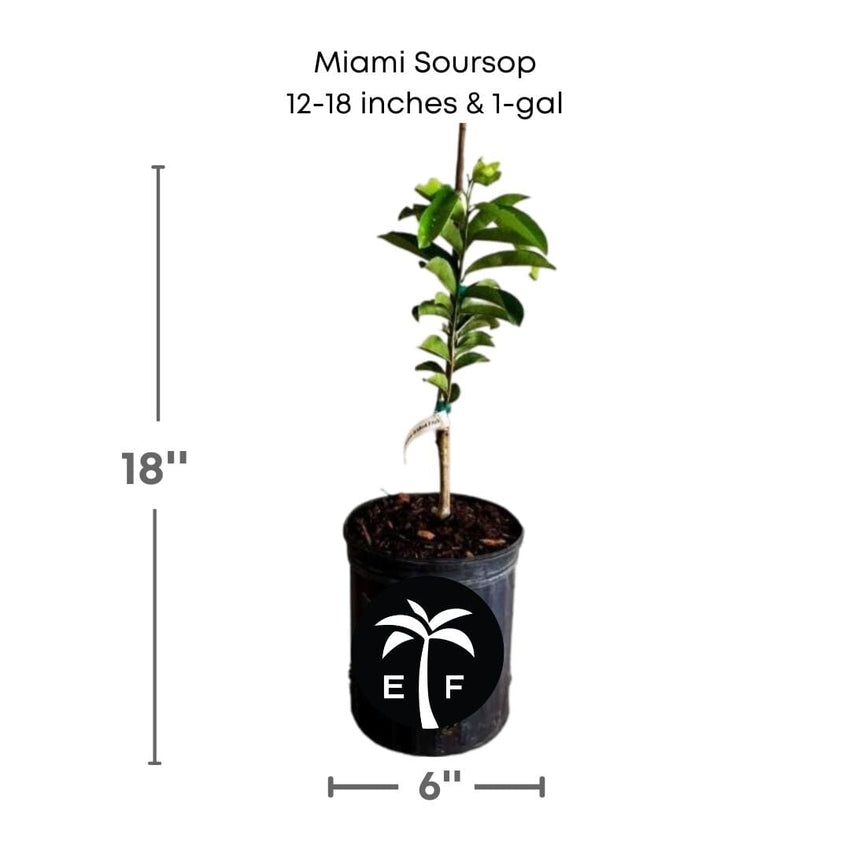
A soursop sold as a baby plant or a starter plant is usually 3-8" tall in a small starter pot, a rooted seedling or a cutting with a few true leaves. It is not fragile, but it is a year or two of growing before it looks like a tree. From there it moves into a one- or three-gallon pot, and then into the ground or a large container.
Mature height is 15 to 30 feet in the tropics and much less in a pot, where annual pruning holds it near 8 feet. The requirements do not change with the stage. Full sun, well-drained soil and frost-free conditions apply to a baby plant and to a fruiting tree alike.
Step 5: Tree age
From seed, expect three to five years before the first fruit. A grafted tree from a nursery will often fruit in two, sometimes sooner, because it is already carrying mature wood. If your tree is young and otherwise healthy, patience is the correct intervention.
Step 6: Cold, wind and humidity
Soursop is not a cold tolerant tree. It is among the more cold sensitive tropical fruit trees there is, and it wants frost-free conditions and warm winters much like it would get in the tropics. Leaf damage begins at temperatures below 5 °c (41 °f), and sustained cold below that kills young wood outright. High humidity suits it. Dry wind does not, and wind during bloom strips flowers before anything sets. At the edge of its range, plant on the south side of a structure, use a windbreak, and be ready to cover a young tree.

Step 7: Container growing and routine care
Container growing is normal for this species outside the tropics rather than a compromise. A tree in a 20 to 25 gallon pot, pruned annually, will fruit. In a potting situation, give it the brightest position you have, raise humidity through winter, and accept that a plant indoors under dry heat will drop some leaves. Repot every second or third year, root prune lightly, and keep the pot off cold concrete in winter.

Soursop Tree Care
Soursop is a heavy feeder while it is carrying fruit and a light one the rest of the year, and most disappointing trees are underfed rather than overfed.
Soil comes first, because fertilizer cannot fix poor drainage. Soursop thrives in rich, fast-draining ground at a pH between 6.0 and 6.5. Because it features a delicate, shallow root system, the tree resents both prolonged drought and waterlogged earth. Sitting in standing water suffocates roots and quickly causes severe leaf drop and dieback. Work compost and organic matter throughout the entire planting site rather than just into the hole. For potted specimens, use a loose potting mix cut with one-third perlite or bark to guarantee sharp drainage.
Establishing a healthy organic soursop tree requires a steady watering schedule. Provide regular irrigation two or three times a week rather than light daily sprinkling, letting the top two inches of soil dry slightly between cycles. Applying copious mulching around the drip line protects the shallow root system, conserves moisture, and prevents weeds, though you should always keep mulch pulled back several inches from the trunk.
Feed a balanced fertilizer every six to eight weeks through the active growing season, then shift toward a bloom formula higher in phosphorus and potassium once flowers appear. Excess nitrogen fuels vigorous leafy growth at the expense of fruit set. A slow-release citrus and avocado blend near an 8-3-9 analysis works well because it includes essential micronutrients like iron and zinc.
If grown on alkaline or limestone ground, apply a chelated micronutrient drench or foliar spray to prevent interveinal yellowing from iron or magnesium deficiencies. For container trees, feed at half strength twice as often to replace nutrients flushed out by frequent watering.
Harvesting Soursop Fruit
This is the step most growers get wrong, because soursop does not look ripe when it is ready to pick.
Watch the skin lighten from dark green toward yellow-green maturity, and watch the spines soften and flatten. Press gently with your thumb. It should give slightly, like a firm avocado. Fruit usually matures four to five months after the flower was pollinated, so marking the bloom date is the most reliable clock you have.
Harvest at that firm stage and let it finish on the counter for two to four days. Left on the tree it will drop and bruise itself, and a bruised soursop sours fast. Cut with shears, leaving a short piece of stem attached rather than pulling.
Halve the ripe fruit, scoop the pulp away from the leathery inedible skin, and pick out the seeds. The pulp goes into smoothies with lime, into ice cream bases with condensed milk, or into jam. Ripe fruit holds three days in the fridge and the pulp freezes well for a year, which is what most growers do with a heavy crop.
A cup of pulp is a reasonable source of vitamin C, dietary fiber, potassium and magnesium, and it carries the polyphenols common to tropical fruit. That is the whole nutritional story, and it is a good one.
How to Eat and Use Soursop
Once your soursop is ripe and soft to the touch, the easiest way to enjoy it is to simply cut it in half and eat the creamy white flesh straight out of the skin with a spoon. Just be sure to pick out and discard the hard black seeds.
The rich pulp is incredibly versatile in the kitchen. Many growers blend it with milk to create a refreshing smoothie or a traditional Caribbean shake. It is also a popular tropical base for homemade ice creams and cooling sherbets. Beyond desserts, an unripe or young fruit can actually be chopped and cooked as a vegetable in savory stews. In some regions, the fermented juice is even used to produce unique batches of wine or distilled into brandy.
Soursop Fruit Benefits
Growing an organic soursop tree in your yard gives you direct access to a fruit packed with essential nutrients. A single cup of the fresh pulp delivers a heavy dose of vitamin C, along with vital minerals like calcium, iron, magnesium, phosphorus, and potassium. The fruit is widely recognized for its high antioxidant benefits, which help the body neutralize harmful free radicals. While medical researchers continue to study the plant's extracts for potential cellular regenerative benefits and laboratory-observed anti-carcinogenic properties, for the home grower, the fruit is best enjoyed simply as a highly nutritious, vitamin-rich addition to a healthy diet.
A Note on Health Claims
Soursop is marketed heavily as an alternative cancer treatment. Cancer Research UK and Memorial Sloan-Kettering Cancer Center both state there is no evidence it works as one in people, and regulators have treated the selling of those spurious claims as consumer protection rather than as a scientific dispute. The US Federal Trade Commission has acted against sellers of unproven products in this category, and in the United Kingdom marketing a graviola product as a cancer cure led to a criminal conviction under the Cancer Act.
We sell soursop trees, and we are not going to tell you the fruit treats anything.
One practical note in the other direction. Soursop leaves and seeds contain annonacin, studied in neurotoxicology as a model neurotoxin, and researchers have linked long term daily use of leaf preparations to parkinsonism risk in one Caribbean population. Eating ripe pulp in normal amounts is fine. Drinking graviola leaf tea every day as a health regimen is the pattern worth avoiding, and discarding the dried seeds, which you would do anyway, removes most of the exposure.
Check out our Soursop Tree Collection!
Troubleshooting
No fruit despite heavy flowering almost always means pollination, and hand pollination is both the test and the fix. Yellowing leaves point to overwatering first and nutrient deficiency second. Flowers dropping without setting is pollination again, or heat and wind during bloom. Dark leaf spots after a wet stretch are fungal and resolve with better air movement through the canopy and less overhead water. A tree that grows vigorously and never flowers is usually getting too much nitrogen.
Getting a soursop tree to fruit is mostly a matter of doing five ordinary things consistently and hand pollinating during bloom. The tree is not difficult. It is just specific.
FAQ
How do you tell when a soursop fruit is ripe?
Watch for the skin to shift from dark green to a lighter yellowish green tone and check for softening spines. Picking right at the cusp of ripeness prevents the heavy fruit from falling and bruising in the outdoor heat, allowing it to ripen safely on your counter.
Why is hand-pollination recommended for soursop trees?
In many home gardens, the native beetles that pollinate Annona species are absent. Hand-pollinating ensures reliable fruit set and leads to a much earlier first crop rather than waiting three to five years from seeding.
What soil and pruning practices help soursop thrive?
Plant in well drained, sandy soil with regular irrigation and copious mulching to shield the shallow root system, preventing leaf drop. Light pruning helps manage tree height and promotes fruiting wood.
Where did soursop originate?
Belonging to the Annonaceae family alongside the cherimoya, custard apple, and sugar apple, Annona muricata is native to tropical regions of the Americas, Central America, South America, and the Caribbean.

